By NECJOGHA News Desk
Closing connectivity gaps is critical to achieving the United Nations’ Early Warnings for All (EW4All) initiative, which seeks to ensure that every person worldwide is protected by timely, life-saving alerts.
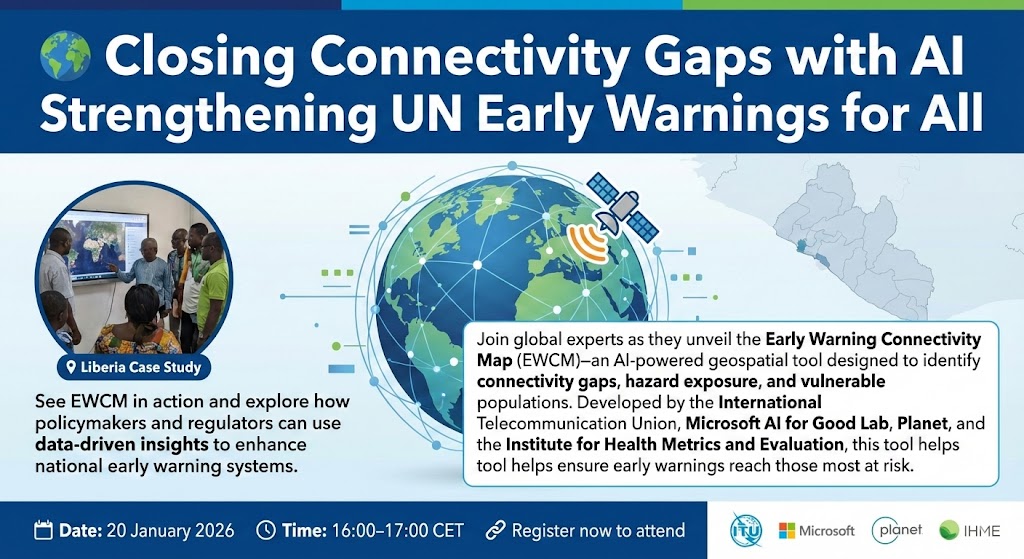
To tackle this challenge, the International Telecommunication Union (ITU), in partnership with Microsoft AI for Good Lab, Planet, and the Institute for Health Metrics and Evaluation (IHME), has developed the Early Warning Connectivity Map (EWCM).
This AI-powered geospatial tool identifies where connectivity gaps overlap with hazard exposure and vulnerable populations. By highlighting these risk zones, EWCM helps ensure that early warnings reach those most at risk, particularly in regions where limited infrastructure leaves communities vulnerable.
Liberia Case Study
The tool will be demonstrated through a Liberia case study during an upcoming AI for Good discovery session, showcasing how policymakers and regulators can use data-driven insights to strengthen national early warning systems.
- 📍 Register at the official link to join the session
- 🗓 Date: 20 January 2026
- ⏰ Time: 16:00–17:00 CET
This initiative marks a significant step in harnessing technology for resilience, ensuring that vulnerable communities are not left behind in the face of climate-related hazards and disasters.
Tags (sentence with commas, no hashtags)
Early warning systems, Connectivity gaps, UN EW4All initiative, International Telecommunication Union, Microsoft AI for Good Lab, Planet, Institute for Health Metrics and Evaluation, Geospatial technology, Artificial intelligence, Vulnerable populations, Hazard exposure, Liberia case study, Policymakers, Regulators, Climate resilience, Disaster preparedness