
Table of Contents
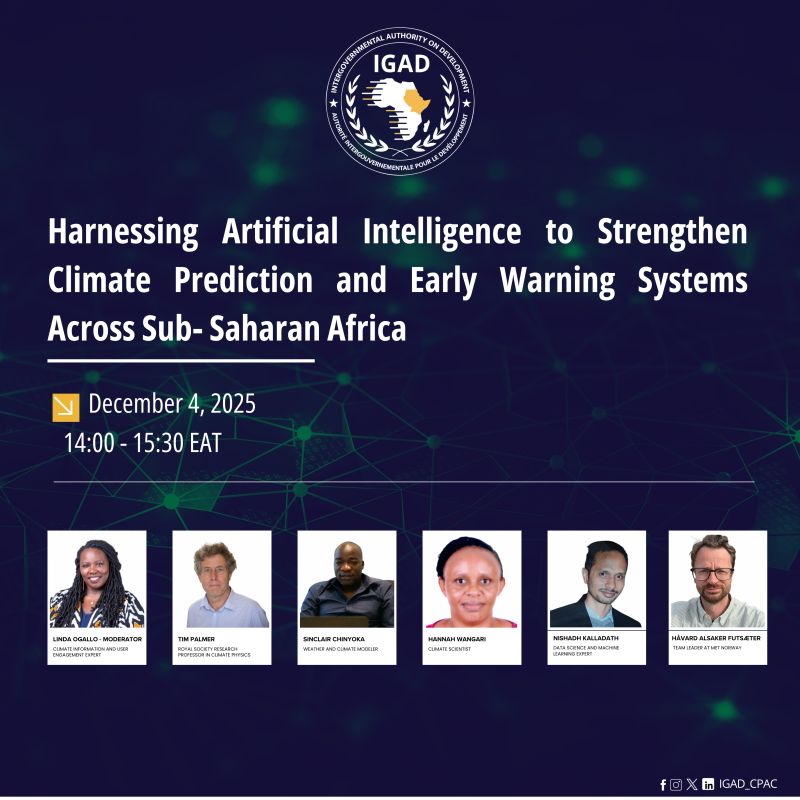
On 4 December 2025, leading climate scientists and innovators will gather virtually to explore how Artificial Intelligence (AI) is reshaping the way Sub-Saharan Africa confronts the growing threat of climate change. The webinar, hosted on Zoom and organised by the IGAD Climate Prediction and Applications Centre (ICPAC), comes at a critical moment for a region facing increasingly unpredictable weather patterns and rising climate risks.
A Region on the Frontline
Sub-Saharan Africa is among the most climate-vulnerable regions in the world. Communities here are already grappling with droughts, floods, and shifting rainfall patterns that threaten food security and livelihoods. Traditional forecasting methods, while vital, often struggle to capture the complexity of these changes. AI and machine learning are now being hailed as game-changers—tools that can enhance accuracy, speed, and the relevance of forecasts.
What the Webinar Will Deliver
The event aims to:
- Showcase AI innovations supporting weather and climate prediction across Africa.
- Highlight pioneering initiatives by National Meteorological and Hydrological Services (NMHSs) and Regional Climate Centres (RCCs).
- Identify pathways for embedding AI tools into operational forecasting systems.
Organisers expect to produce a technical summary document outlining strengths, gaps, and integration pathways, while also raising the visibility of Africa’s AI-driven climate innovations on the global stage.
Harnessing Artificial Intelligence to Strengthen Climate Prediction in Sub-Saharan Africa
The Voices Leading the Conversation
The panel brings together a distinguished line-up of experts:
- Tim Palmer, University of Oxford, a pioneer of ensemble prediction systems and recipient of the IMO medal.
- Sinclair Chinyoka, Weather and Climate Modeler, specialising in numerical weather prediction and machine learning integration for Africa.
- Nishadh Kalladath, ICPAC, advancing impact-based forecasting systems for East Africa using Bayesian networks and ensemble prediction.
- Håvard Alsaker Futsæter, MET Norway, leading efforts to expand the AI-WP model Bris into African domains.
- Hannah Wangari, Kenya Meteorological Department, spearheading early warning systems and high-impact forecasting for vulnerable communities.
- Linda Ogallo, ICPAC, serving as moderator and expert in climate information and user engagement.
Why It Matters
For millions across Sub-Saharan Africa, the difference between a reliable forecast and a missed warning can mean the loss of crops, homes, or lives. AI offers the potential to bridge critical gaps—combining traditional numerical models with machine learning to deliver forecasts that are not only more accurate but also more actionable.
By integrating these technologies into national and regional systems, Africa could strengthen its resilience, improve disaster preparedness, and ensure that communities receive timely, life-saving information.