

By Judith Akolo

NAIROBI—Climate experts have called for anticipatory action and informed usage of the March, April to May long rains seasonal forecast. At the release of the long rains seasonal forecast, the climate scientists said the country is facing a season of both good rains in the agriculturally potential areas as well as poor rainfall in the pastoralist regions of the country.
The Acting Director of Meteorological Service Edward Muriuki while announcing the forecast during the 12th National Climate Outlook Forum (NCOF12), held in Nairobi, with the theme “From Crisis Response to Climate Preparedness: Inclusive Early Warning Services for All,” said the climate outlook for the March–April–May (MAM) 2026 season indicates that near-average to above-average rainfall is expected over the Lake Victoria Basin, the Highlands West of the Rift Valley, the Highlands East of the Rift Valley, including Nairobi, the Rift Valley, and parts of North-western Kenya.
This includes the counties of: Nandi, Kakamega, Vihiga, Bungoma, Siaya, Busia, Baringo, Nakuru, Trans-Nzoia, Uasin-Gishu, Elgeyo-Marakwet, West-Pokot, Kisii. The others are Nyamira, Kericho, Bomet, Kisumu, Homabay, Migori and Narok Counties, Turkana and Samburu Counties. The rest are; Nyandarua, Laikipia, Nyeri, Kirinyaga, Murang’a, Kiambu, Meru, Embu, Tharaka-Nithi and Nairobi Counties
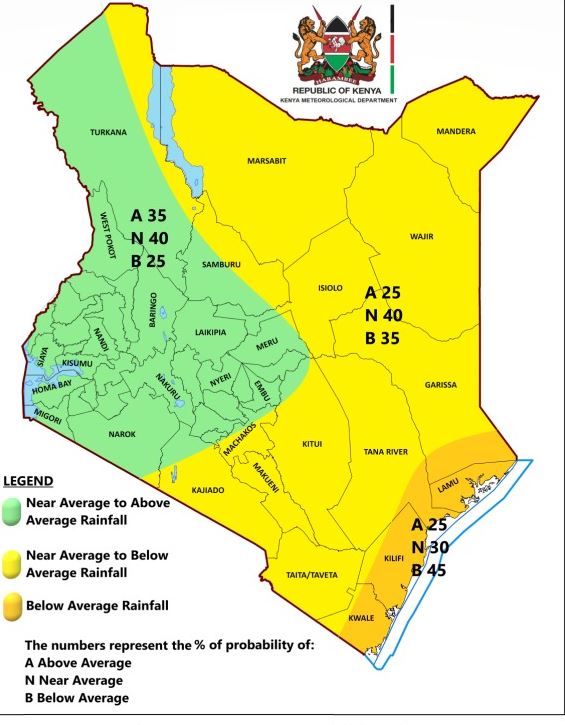
According to the forecast, near-average to below-average rainfall is expected over the Southeastern Lowlands, Northeastern, and parts of Northwestern Kenya. These are the counties of Marsabit, Mandera, Wajir, Garissa and Isiolo, Machakos, Kitui, Makueni, Kajiado and Taita-Taveta Counties as well as the inland parts of Tana-River County.
Muriuki noted that while below-average rainfall is expected over the Coastal region in the counties of Mombasa, Kilifi, Lamu and Kwale Counties as well as the coastal parts of Tana-River County, “occasional heavy rainfall events are likely to occur in a few areas,” he said and added, “intra-seasonal drivers of variability, such as tropical cyclones and the Madden–Julian Oscillation (MJO), which are only predictable at shorter lead times, can significantly influence the expected seasonal outcome.”
He noted that the onset of the long rains season is expected to begin in February in counties in the Highlands West of the Rift Valley, Lake Victoria Basin, Central, and South Rift Valley, “and is expected to go on into June,” said Muriuki and added, “Highlands East of the Rift Valley including Nairobi County, the onset is expected in the second and third week of March, with the distribution expected to fair to good.”
The Southeastern Lowlands will have its onset in the 3rd to 4th week of March with the cessation in the 3rd to 4th week of May with the distribution being poor. North Coast will have its onset in 2nd to 3rd week of April and continue into June with the distribution expected to be poor while the South Coast will have its onset in the 1st to 2nd week of April and continue into June even as its distribution is expected to be poor.
“The season is projected to have a generally poor to fair temporal and spatial distribution of rainfall across several areas. A normal to late onset is anticipated, accompanied by intermittent dry spells. Nevertheless, isolated heavy rainfall events may occur in some parts of the country”, said Muriuki, the Actingg Director Meteorological Services
The North Western; Turkana and Samburu counties as well as the North Eastern region will see its onset in the 4th week of March to the 1st week of April with the cessation expected in the 3rd to 4th week of May with the distribution expected to the poor.