
By NECJOGHA News Desk — November 15, 2025
Mogadishu, Somalia — The Somali Disaster Management Agency (SoDMA) has issued a nationwide drought emergency advisory following consecutive failed rainy seasons and alarming forecasts of below-average rainfall for the October–December Deyr season. The advisory, released earlier this week, marks a critical escalation in the country’s ongoing climate crisis and calls for urgent, coordinated humanitarian action.
According to the IGAD Climate Prediction and Applications Centre (ICPAC), the Horn of Africa is facing one of its most severe droughts in recent history. Eastern and northern Somalia are currently the hardest hit, but conditions are rapidly deteriorating across central and southern regions, threatening millions of lives and livelihoods.
“This is not just a seasonal anomaly it’s a deepening emergency,” SoDMA stated. “The failure of rains has compounded existing vulnerabilities, pushing communities to the brink and triggering widespread displacement, water scarcity, and food insecurity.”
Commissioner Mahamuud Moallim warns that seasonal rains expected from October to December will be delayed, posing a serious threat to Somalia’s agriculture, livestock, and livelihoods. His statement reinforces the urgency of the advisory and highlights the cascading impacts of climate shocks on rural communities and national food systems.
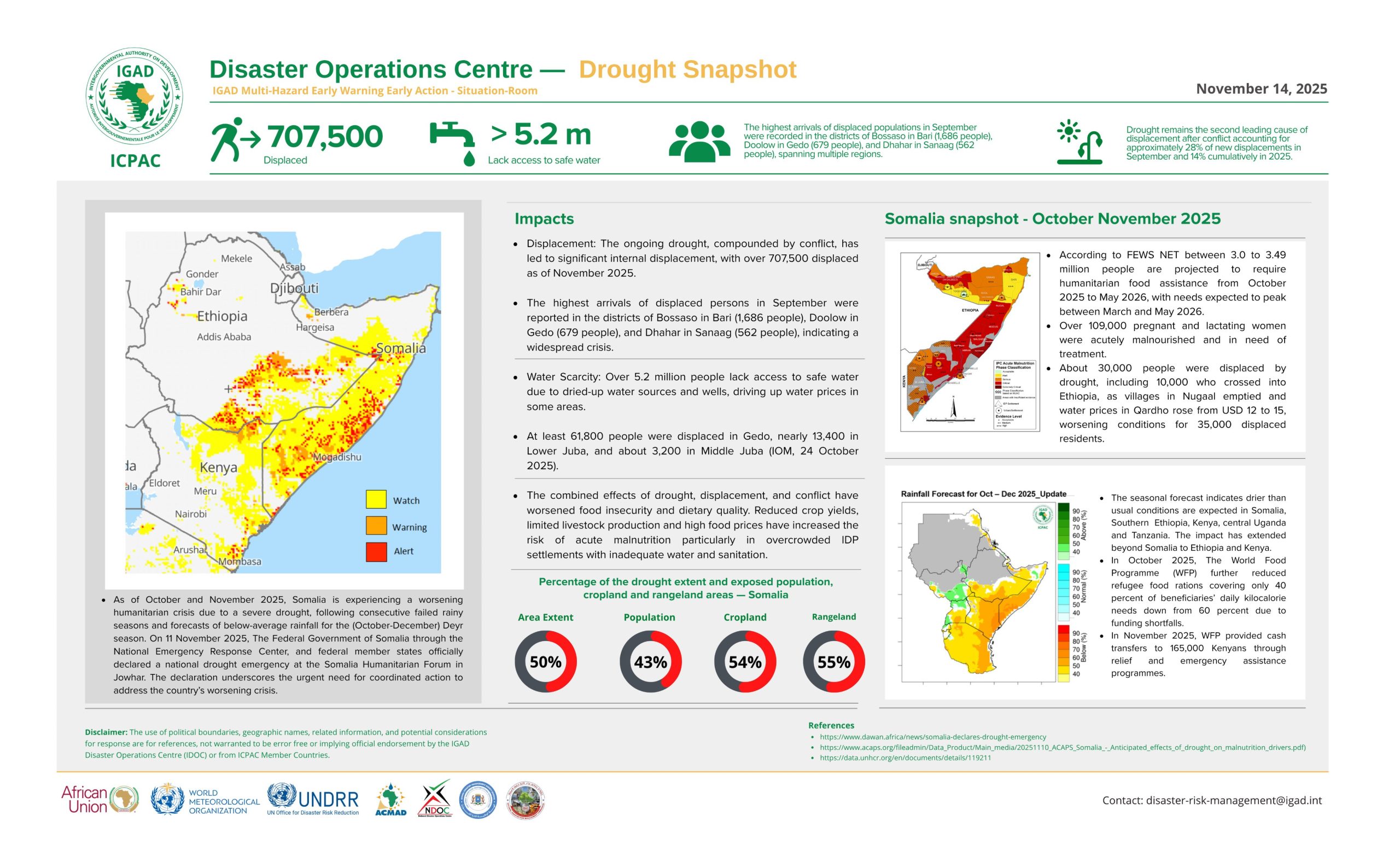
As of November 14th 2025; recent data from IGAD’s Multi-Hazard Early Warning Situation Room reveals that over 707,500 people have been displaced, and more than 5.2 million lack access to safe water across Somalia, Kenya, and Ethiopia. In Somalia alone, 30,000 people have been displaced by drought, including 10,000 who have crossed into Ethiopia seeking relief. Water prices in Qardho have surged from USD 12 to USD 15, further straining household resilience.
The humanitarian outlook remains grim. Between 3.0 to 3.49 million Somalis are projected to require aid from October 2025 to May 2026, with over 109,000 pregnant and lactating women suffering from malnutrition. Crop failures and livestock losses have intensified food insecurity, while funding shortfalls have forced the World Food Programme (WFP) to cut refugee rations to just 40% of daily needs.
In response, 165,000 Kenyans received emergency cash transfers in November, but regional actors warn that broader, sustained interventions are needed. IGAD’s climate models predict continued below-average rainfall across Somalia, southern Ethiopia, Kenya, central Uganda, and northern Tanzania.
SoDMA’s advisory urges national and international partners to mobilize resources, scale up emergency response, and strengthen early warning systems. “The time to act is now,” the agency emphasized. “Without immediate support, the crisis will deepen, and recovery will become even more difficult.”