By NECJOGHA News Desk | Nairobi
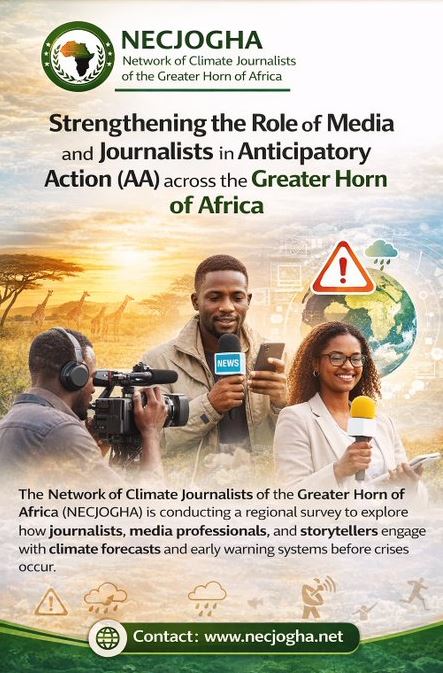
The Network of Climate Journalists of the Greater Horn of Africa (NECJOGHA) has launched a regional survey to map how journalists, media professionals and storytellers across the region engage with climate forecasts and early warning systems before disasters strike part of a wider push to position the media as a frontline actor in anticipatory action.
Anticipatory Action, often shortened to AA, refers to humanitarian and community measures taken on the basis of forecasts before a hazard becomes a crisis. Where traditional disaster response begins after damage is done, anticipatory action begins when a credible warning is issued and ideally even earlier, when the climatic conditions that produce such warnings are first detected.
The survey, the network said, seeks to understand how reporters and editors across the 11 countries of the Greater Horn currently use seasonal forecasts, drought watches, flood bulletins and other early-warning products from agencies such as the IGAD Climate Prediction and Applications Centre (ICPAC), national meteorological services. It also aims to identify the gaps in access, in technical literacy, in editorial appetite that prevent forecasts from translating into stories communities can act on.
“Communication is aid,” the network said in a statement announcing the survey. Strengthening communication delivery systems ahead of emergencies, and ideally before early warnings are even issued, is vital to saving lives and minimising losses, NECJOGHA said, adding that defining the role of media in anticipatory action would empower communities to act early, protect themselves, and safeguard their livelihoods against climate-related threats.
“Journalists are not just messengers we are part of the early warning system itself,” said David Luganda, Coordinator of NECJOGHA. “When a forecast doesn’t reach the herder in Turkana or the farmer in Karamoja in time, the failure isn’t only with the science. It’s with us.”
The initiative comes against a backdrop of rising forecast skill in the region but persistent gaps in the “last mile” of warning communication. ICPAC’s Greater Horn of Africa Climate Outlook Forum (GHACOF) issues seasonal outlooks before each rainy season, and national met agencies in Kenya, Ethiopia, Uganda, Tanzania, Rwanda and elsewhere produce regular advisories. Yet successive droughts and floods including the 2020–2023 Horn drought and the 2024 long rains floods that killed hundreds across Kenya, Tanzania and Somalia have repeatedly exposed how unevenly such warnings reach the pastoralists, farmers, fisherfolk and urban poor whose lives depend on them.
The role of journalists in closing that gap, the network argues, is not simply to relay official advisories but to translate, contextualise and follow them through to action: explaining what a probabilistic forecast means in plain language, identifying who in a given county or district is most exposed, and reporting on whether the agencies tasked with response are actually mobilising.
The survey is open to journalists, editors, communicators, broadcasters and storytellers working on climate, environment, humanitarian or development issues across Burundi, Djibouti, Eritrea, Ethiopia, Kenya, Rwanda, Somalia, South Sudan, Sudan, Tanzania and Uganda. Findings will be used to shape training, editorial resources and partnerships aimed at embedding anticipatory action more deeply in regional climate journalism.
Take part in the survey here: https://docs.google.com/forms/d/e/1FAIpQLSdYGLwITTPLfHCOtKRSwJzxes_BuiPCUaBoVmVdxPPgxGPoRA/viewform
Follow the conversation across X and other platforms using #Media4AA.